nail gun
American PsychoThe nail gun is one of the most materially specific instruments in Patrick Bateman’s repertoire of violence. Bought as a new object and kept in his apartment, it begins as a piece of consumer hardware but becomes a device through which bodies are immobilized, pain is staged, and violence is turned into something repeatable and observable. Its significance lies not only in what it does, but in how precisely it belongs to the world of branded possessions, private display, and controlled surfaces that surrounds Bateman.
Acquisition and Domestic Placement
Patrick Bateman keeps the nail gun in an Anaholian white-oak armoire in his apartment, where it is stored alongside the carefully selected furnishings and named products that define his domestic environment. He purchased it only the previous week at a hardware store near his Wall Street office, making the weapon another recent acquisition within a life organized around consumption and novelty. The placement matters: the nail gun is not hidden in an improvised outdoor location but housed among the apartment’s designed objects, close to the Wurlitzer 1015 jukebox and the David Onica painting.
When Bethany visits, Bateman locks and bolts the door, pours himself a drink, puts on black leather gloves, and checks that the nail gun is loaded. These preparations give the object a ritual function. It is inspected, armed, and brought into use with the same deliberate attention that Bateman gives to clothing, alcohol, furniture, and entertainment equipment. The gun therefore exposes the apartment’s apparent refinement as a surface that can be converted almost instantly into a controlled scene of violence.
Use Against Bethany
The nail gun first becomes central during Bateman’s attack on Bethany. When she sees it, she attempts to reach the front door, but Bateman moves in front of her and uses the gun to strike her repeatedly in the head, knocking her unconscious. He then drags her onto a white cotton sheet and places her hands flat on wooden boards. The tool changes her body from a mobile person into a fixed arrangement within the room: its practical capacity to fasten materials becomes a means of fastening a victim.
Bateman nails three fingers on each of Bethany’s hands to the boards, then continues shooting nails until both hands are covered. The nails become visibly tangled and bunched together, making it impossible for her to sit up. Her attempts to move leave black scuff marks on the stained white oak, so the weapon also produces a new trace on the apartment itself. The scene’s violence is inseparable from its domestic setting: the floor, sheet, coat, gloves, and nail gun form a coordinated arrangement in which household surfaces become part of the attack.
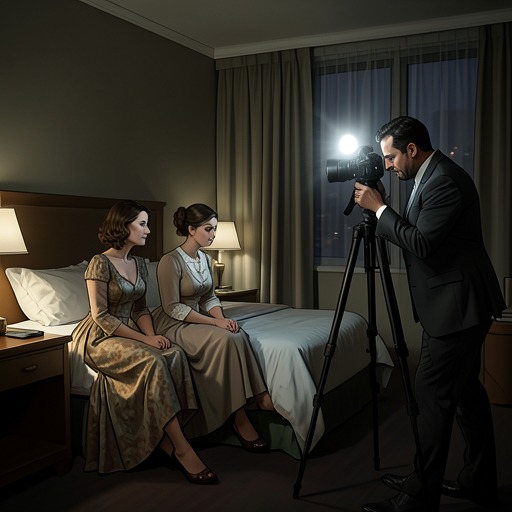
The object is used alongside other forms of sensory and bodily control. Bateman sprays Bethany with Mace, covers her head with a camel-hair coat to suppress her screams, and later sets up a Sony Handycam to film what follows. The nail gun thus operates within a larger apparatus of immobilization and spectatorship. It does not merely injure Bethany; it helps make her helplessness visible and repeatable, converting assault into a private production whose setting, tools, and images are controlled by the perpetrator.
Recurrence and Escalation
The nail gun returns in the later attack on Torri and Tiffany. There, Bateman uses its butt to knock both women unconscious after spraying them with Mace. The same object consequently shifts between two functions: its body is a blunt instrument for producing unconsciousness, while its firing mechanism serves as a means of fixing and damaging flesh. This recurrence gives the nail gun a recognizable role in Bateman’s method, joining scenes that otherwise differ in participants and elaboration.
In the Torri and Tiffany scene, the nail gun is accompanied by a miniature camera and a portable CD player used to mute screams. Torri’s death is filmed with a Minox LX camera, while Tiffany is restrained and forced to watch. The nail gun therefore belongs to a technological cluster rather than appearing as an isolated weapon. Tools record, silence, bind, and strike at once; violence becomes mediated through consumer devices whose precision and portability mirror the controlled surfaces of Bateman’s professional and social life.
The object’s repeated use also reveals a movement from ordinary utility toward ritualized domination. A device bought at a hardware store becomes part of a private vocabulary of restraint, then reappears as though its function has been established. Its material identity remains stable while its social meaning changes: it is first a purchase, then a concealed threat, then an instrument of bodily fixation, and finally one component in a staged spectacle involving cameras, music, and an audience forced to witness.
Materiality, Evidence, and Narrative Uncertainty
The nail gun’s detailed physical presence creates an impression of concrete evidence within a narrative otherwise marked by uncertainty. Bateman identifies where he bought it, where he stores it, whether it is loaded, and what protective gloves he wears before handling it. Such details give the object the density of a forensic exhibit. Yet the surrounding violence is narrated through Bateman’s unstable first-person consciousness, and the novel repeatedly leaves open the relation between confession, fantasy, memory, and externally verifiable event.
That tension makes the nail gun more than a symbol. It is an object that seems capable of anchoring the narrative in material fact, even as the narration’s credibility remains unsettled. The gun’s nails enter wood, hands, and skin; they leave arrangements that appear measurable and visible. At the same time, the object is absorbed into Bateman’s theatrical language of control, where tools and bodies are organized for his private attention. Its apparent evidentiary solidity therefore coexists with the novel’s larger instability between appearance and reality.
The nail gun also embodies the moral displacement that accompanies Bateman’s violence. Before and during the attacks, he reduces victims to surfaces, parts, and obstacles, while the weapon allows him to treat a person as material to be fastened or struck. The tool does not cause that dehumanization by itself, but its ordinary industrial purpose is repurposed within it. In Bateman’s hands, a consumer object participates in an assemblage of clothing, architecture, recording equipment, alcohol, and language that makes cruelty seem organized, repeatable, and temporarily manageable.
Thematic Significance
As a recurring object, the nail gun condenses the novel’s conjunction of consumerism and violence. It is new, purchased near Wall Street, stored in a designer apartment, and integrated into a world of branded goods. Its conversion into a weapon exposes the continuity between Bateman’s consumer identity and his murderous practice: both depend on acquisition, selection, display, and the fantasy that every object can be made to serve his will.
Its most disturbing force comes from the contrast between familiarity and use. A nail gun belongs to construction and repair, yet Bateman uses it to destroy, restrain, and stage suffering. The reversal turns domestic order against itself. White boards, polished floors, an armoire, gloves, and a camera do not protect the apartment from disorder; they provide the setting and equipment through which disorder is methodically produced. The nail gun is consequently both an instrument and a piece of evidence in the collapse of civilized appearance into spectacularized violence.